Salvation: Relationship or Commodity?

“For I feel a divine jealousy for you, since I betrothed you to one husband, to present you as a pure virgin to Christ.” 2 Corinthians 11:2 ESV
“…so that he(Jesus) might present the church to himself in splendor, without spot or wrinkle or any such thing, that she might be holy and without blemish. In the same way husbands should love their wives as their own bodies. He who loves his wife loves himself. For no one ever hated his own flesh, but nourishes and cherishes it, just as Christ does the church, because we are members of his body. “Therefore a man shall leave his father and mother and hold fast to his wife, and the two shall become one flesh.” This mystery is profound, and I am saying that it refers to Christ and the church.” Ephesians 5:27-32 ESV

engaged


Growing up in the 21st century within a capitalist culture is challenging for one to fully grasp the teachings of the Bible. Take for example the concept of salvation. Is salvation a commodity to be exchanged or a relationship to be experienced?

There are those who believe that upon repentance one receives salvation. We exchange our repentance for a one-way ticket to heaven. Then there are those who believe that salvation occurred approximately 2,000 years ago upon Jesus’ death, resurrection, and ascension. That upon accepting the reality of who Jesus is, we begin to experience the fruit of salvation.

I lean towards the second view. When we view salvation as a byproduct of our effort, we are treating salvation as a commodity. However, when we view salvation as an engagement, than we are treating salvation as a relationship.

The apostle Paul used the analogy of being engaged to Jesus Christ. In Paul’s time it was the man who selected his wife-to-be. He would work out the arrangement with the woman’s father. If the father approved, he gave his daughter to him. In a sense, the woman would wake up and discover who her husband is to be. She didn’t choose her husband. It wasn’t a decision she made. She simply acknowledged the reality that she was engaged to be married. Thereafter, she focuses herself in accepting the relationship of her husband-to-be and accordingly changed her thinking and behavior to that reality.

Salvation is likewise an engagement in a marriage relationship from a 1st century woman’s perspective. What saves us is not our decision. What saves us is Jesus Christ who became engaged to us before we even accepted that reality. When we wake up from our spiritual sleep, accept that reality, then we begin to experience the fruit of salvation. Otherwise, if salvation is a business transaction, a commodity that we acquire, then it has the weak link of a human decision. We will always doubt our level of repentance, faith, trust, or works. Or in other words, how good is good enough.

When I beheld salvation as a relationship and no longer a commodity is when the fruit of God became more active and the heart of God became more intense within my very soul. I for one am very thankful that Jesus Christ re-opened the door for us to have a relationship with Him, His Father, and His Spirit: The Triune God. How about you?


Rooting For You in Christ!

Dr. Mike

Executive Chair, Consultant, Encourager
Marketplace Bible Institute
& Resource Center, Inc
Author of e-Books:
 *  Great Business Emulates a Good God
 *  Be Radical…Follow Christ!
 *  Simply The Messenger
 *  Unequally Married

Relate or Influence

” For this is the message that you have heard from the beginning, that we should love one another.” 1 John3:11 ESV

love lead

What do you seek from your relationships? Friendship? Love? Intimacy? Or do you simply use people for your personal agenda?

The older I become the more thankful I am for the friends and family in my world. What I realize now more than ever is that I didn’t go about asking them to change for me nor I for them. Instead, we accept each other as who we are and learn to appreciate each other as God created and gifted us. Whereas in the workplace in those early years, I made the immature mistake of wanting to change others. The focus was on influencing them by whatever means at my disposal. My goal wasn’t to build a mutual, beneficial, unconditional relationship, but to accomplish my agenda for the day.

Isn’t that how many of us relate with others? We either accept them for who they are or we try to influence them to change. That includes our children, parents, siblings, and yes our mates.

The other day I overheard a young woman who was recently married state that she loves her husband but there are a few things she is going to have to change about him if they are going to have a successful marriage. It brought back memories of my early married days when there were certain habits that my wife had (and still has) that I was going to change. Likewise, she would admit that there were many habits that I had (and still have) that she was going to change. Thankfully, we learned early enough that one can’t successfully change the other person from the outside-in. Instead we focused on building up the relationship rather than persuade the other person to our point of view.

Think about your relationships. Is the goal to mutually enjoy the love, friendship and maybe even the intimacy of marriage? Or is the goal to influence the other person to change for your sake?

I am always amazed at how Jesus related with other people. Have you ever noticed that His tenancy was to first relate with people by actually taking the time to love them and respect them for who they were? When verbally attacked, he would defend himself with the appropriate answer. The only time he emotionally exploded was in the temple with the money changers and again with the self-righteous religious leaders who constantly tried to trap him (even then it could be debated that he was practicing tough love techniques). Otherwise, he spent his time solving people’s problems. He healed them. He ate with them. He partied with them. And as a rabbi, he taught them.

His primary focus was to first love the people wherever he went. His influence came later through the people who he invested time with during his 3 1/2 year ministry. His influence was a byproduct of his relationship. He loved first; and then let his love be the influence that transformed lives in and through others. Isn’t that a good plan for all of us to follow?

Rooting For You in Christ!

Dr. Mike

Executive Chair, Consultant, Encourager
Marketplace Bible Institute
& Resource Center, Inc
Author of e-Books:
 *  Great Business Emulates a Good God
 *  Be Radical…Follow Christ!
 *  Simply The Messenger
 *  Unequally Married
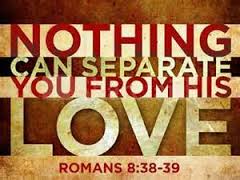
Separation

“For I am sure that neither death nor life, nor angels nor rulers, nor things present nor things to come, nor powers, nor height nor depth, nor anything else in all creation, will be able to separate us from the love of God in Christ Jesus our Lord.” Romans 8:38-8 ESV

separate 1

Sometimes people remark that I may confuse the issue because of little details that don’t tie up all the loose ends. For example, the concept of sin and separation from God.

I grew up believing when I sinned God was angry at me. That sin was repulsive to God. That He would turn His back to me. That sin prevented God from blessing me. In some ways, it seemed that Sin was bigger than God. That God didn’t want to have anything to do with me because of that sin I committed last night without even being aware of it. Somewhere, someplace I was led to believe that I was the problem of sin. That when I sinned, God separated Himself from me.

It now amazes me more than ever what happens when the truth becomes known. For example, Father/Son/Spirit God is truly greater than any sin ever committed or known on planet earth. Jesus, who represents God on earth for humanity to witness, walked among sinners. He worked, played, and ate with sinners. He deliberately spent time with them. He didn’t separate himself from sinners. Instead he conquered sin for us.

When we sin, God doesn’t walk away from us. He doesn’t turn his back to us. Instead, he pursues us even more so. He knows the ramifications of sin. He witnessed it with Satan. Yet He still allowed Satan to hang around heaven (Job 1:6). When Adam and Eve sinned, He didn’t walk away from them. Instead he came looking for them. It was they who hid from God. It was they who became afraid and sought to hide from God.

When we sin, we hurt ourselves. We hurt those around us. Our mates, children, parents, friends, and associates all are recipients of sin’s poison. God doesn’t turn away from us. Those around us may, but God doesn’t. He wants us to realize his forgiveness. And because of his forgiveness, he wants us to repent. He wants us to be truly thankful for what He does for us. Showering us with constant grace and care.

Whenever the nation Israel fell into the practice of idolatry, God would patiently wait for the proper moment before he would intercede and bring the nation back into the fold. Whenever we sin, God likewise waits patiently for us before he intercedes and brings us back to him. When King David committed adultery and murder, God used the prophet Nathan to bring the sin to his attention. When realizing his sin, David quickly repented. God didn’t disown David. Instead, He helped David to grow in maturity and responsibility. He does the same for you and me today.

Sin doesn’t separate us from God. It blinds us from seeing God. It may block God’s Spirit from freely flowing through us. But God is always there. He loves us. Wants what is best for us. In some ways, He uses sin to help us appreciate and grow in his grace. Like King David, when we are convicted of sin, we quickly repent. In repentance, we are thankful for the life He shares with us, His grace, His mercy, and everything else he has reserved for us.

Rooting For You in Christ!

Dr. Mike

Executive Chair, Consultant, Encourager
Marketplace Bible Institute
& Resource Center, Inc
Author of e-Books:
 *  Great Business Emulates a Good God
 *  Be Radical…Follow Christ!
 *  Simply The Messenger
 *  Unequally Married

Learn. Integrate. Grow.