Faith in What?

Whenever someone says that they have faith, the question arises, “faith in what or whom?”

If you probe enough in a person’s narrative, you will find the worldview that the person builds their reality from.  Is their foundation for “faith” in happen-chance? a “faith” in self? a “faith” in another person? a “faith” in “big brother?” or a “faith” in “karma?” Wherever the faith is focused toward reveals the person’s source of life and their reality.

In political slogans, we are asked to have faith. In business circles, we are asked to have faith. In relationships, we are asked to have faith. Faith is one of those words that has become a generic, abused child. However, when faith is properly employed, reality becomes more real in a person’s life. When faith is built on a true, solid foundation than kingdom reality becomes a life-giving source that makes oneself and those around him/her to flourish.

If someone is looking for a Biblical definition of faith, check out chapter eleven of Hebrews. If you want a another practical definition, substitute the words belief and trust in the work of the Triune God every time you come across the faith word. It will give you a more precise meaning of the word faith as used in scripture. But for those whose basis is not scripture, faith is only an empty cliché to distort the power and grace of God. Yet be not surprised, Biblical words and concepts have slowly eroded over time to become a water down version of its original meaning. That is why we all need to become practicing theologians to some degree.
faith

My belief and trust is in Jesus Christ. He allows us to take part with Him in His story which is restoring creation back to God’s original intent. He has my back. My belief and trust is built on His faith, His work of salvation, His plans for humanity, and His ability to make it all happen for  His goodness and the goodness of all under His dominion.

So the next time you hear someone mention faith, be sure you both have the same definition of faith in mind. Otherwise, who is being radical and missing out in the enjoyment of life in Christ?

Dr. Mike
Ministry Insights From a Tent Maker

 theology 6

Paul worked for 1 ½ years with a husband and wife team (Aquila and Priscilla) while conducting missionary work in Corinth (Acts 18:2).  While working as a tent maker, he continued to teach the Word in the local synagogue.  It is of interest how he employed the word “work” throughout his life and teachings, especially in relationship to what God is doing and what His people are doing.  The importance of work is highlighted throughout his letters.

Luke quotes Paul in Acts 20:32-35, ”You yourselves know that these hands of  mine have supplied my own needs and the needs of my companions. In everything I did, I showed you that by this kind of hard work we must help the weak, remembering the words the Lord Jesus himself said: ‘It is more blessed to give, than to receive.'”

In the letter from Ephesians 4:28 Paul writes, “He who has been stealing must steal no longer, but must work, doing something useful with his own hands, that he may have something to share with those in need. In 1 Thess 4:11-12 he writes, “make it your ambition to lead a quiet life, to mind your own business and to work with your hands, just as we told you, so that your daily life may win the respect of outsiders and so that you will not be dependent on anybody.”

In the above scriptures Paul emphasized the point of working to support oneself and one’s family rather than live as a beggar dependent on others for necessities. Paul himself demonstrated the importance of having a skill (tent making) that provides a service to others (shelter) and a livelihood for oneself. A Christian is to gladly work “unto the Lord” (Col 3:22-24).  The work one does should not glorify oneself, but God.  In addition, the work should be a means to provide for those less fortunate – “it is more blessed to give than to receive.”

Also, as work relates to fulfilling God’s plan, He writes in Titus 1:7 that “an overseer is entrusted with God’s work.” Barnabas and Paul was set apart by the Holy Spirit for this work (Act 13:2-3). And not only were they commissioned for this work, but had to support themselves in the process (I Cor 9:6).  He again writes how one’s work for the Lord must stand the test of trials, difficulties, problems,  especially when we shall all be evaluated at the end of this age (I Cor 3:10-15).

He was primarily focused on the Lord’s work and only labored to support himself and his team, not to gain riches. He practiced what he preached.  The work of the Lord was the priority in his life and for all those that the Lord calls (I Cor 15:58, 16:9,10).  While working his craft, he contemplated and compared the physical craft of tent making to the spiritual work God is completing in us as a church and as an individual. His analogy of the body working together as a team with all its parts supporting one another is but one example of lessons learned while working (I Cor 12:12-13).

All tent-makers need to stand up and rejoice.  It is an example for all people everywhere that the craft, skill, profession, and work we perform is more than just to feed ourselves.  It’s a means of grace that we practice.  When we work, we are able to support those less fortunate than ourselves and therefore practice love of our neighbor.  When we work, we learn how God operates in our lives.  When we work, we are able to compare and better understand the spiritual realities we face each day.  When we work, we are able to express ourselves by the results of our labor.  When we work, we contribute to the community we reside in.  There are many valuable lessons we learn while we work. To paraphrase Jesus, “God works, and so do I.”

What other insights of ministry do you think Paul may have received while engaged as a tent maker?

Dr. Mike

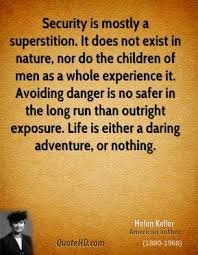
What is Your View on Security?

How much greater becomes life when we accept the adventurous journey of transformation in Christ for the sake of others?

Adventure